 Holo
Holo
Project
application:
Education
B.
ø
Holograms are increasingly being integrated into education to enhance learning experiences, engage students, and facilitate understanding of complex concepts.
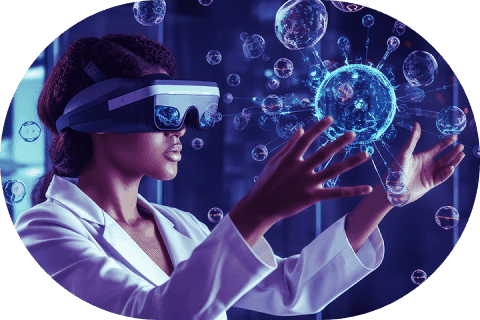

Interactive
Learning Modules
Holograms can be used to create interactive learning modules that allow students to explore subjects in a dynamic and immersive way.
For example, in science classes, holographic simulations can visualize abstract concepts such as molecular structures, the solar system, or cellular processes, enabling students to interact with and manipulate virtual objects to better understand scientific principles.

/01
Virtual
Field Trips
Holographic technology can simulate real-world environments and historical settings, allowing students to take virtual field trips without leaving the classroom.
Whether it's exploring ancient civilizations, visiting landmarks, or studying ecosystems, holographic field trips provide students with opportunities for experiential learning and firsthand exploration of subjects that may otherwise be inaccessible.
/02
Anatomy
& Medical Training
In medical education, holograms are used to visualize anatomical structures and medical procedures in three dimensions.
Medical students can study the human body in detail by interacting with holographic representations of organs, tissues, and systems, gaining a deeper understanding of anatomy and physiology. Holographic simulations can also be used for surgical training, allowing students to practice procedures in a realistic virtual environment.
/03
Historical &
Cultural Education
Holograms can bring history and culture to life by recreating historical events, figures, and artifacts in a vivid and interactive manner.
Students can witness key moments in history, interact with virtual historical figures, and explore cultural artifacts in detail, fostering a deeper appreciation and understanding of the past.
/04
Language
Learning
Holographic technology can facilitate language learning by providing immersive language immersion experiences.
Students can interact with holographic avatars or virtual environments where they can practice conversational skills, receive real-time feedback, and engage in interactive language exercises. This immersive approach to language learning helps students develop proficiency and confidence in speaking a new language.
/05
Collaborative
Learning
Holograms enable collaborative learning experiences where students can work together on projects and experiments in virtual environments.
Whether it's solving complex problems, conducting virtual experiments, or collaborating on creative projects, holographic technology fosters teamwork and communication skills while providing opportunities for hands-on learning.
/06
Special
Education
Holograms can be particularly beneficial for students with special needs or learning disabilities.
Interactive holographic simulations can accommodate different learning styles and provide personalized learning experiences tailored to individual needs. Visualizing concepts in three dimensions can enhance comprehension and engagement for students with diverse learning abilities.
Overall, holograms have the potential to revolutionize education by providing immersive, interactive, and personalized learning experiences that engage students and empower educators to teach complex subjects in innovative ways.
As holographic technology continues to advance, we can expect to see even more creative applications of holograms in education, further enhancing the learning journey for students of all ages.
/06